

Applied Physics uncovers life’s hidden mechanics and how to use them. One physics-based framework with AI prompt each month to transform effort into compounding assets. If someone forwarded this to you, subscribe here.

Eminem could outrap almost anyone in the room. But the crowd wasn’t embracing him.
He had the technical skill with the intricate rhyme schemes, sharp delivery, clever wordplay. He’d been studying hip-hop obsessively since childhood, memorizing every word, understanding how cadences worked. By his mid-teens, he was competing in freestyle battles at Detroit’s Hip Hop Shop, one of the most ruthless proving grounds in the country.
In battles, opponents attacked what made him different: white in a different culture, broke, unstable family, absent father. Every time they did, he got defensive or angry. The crowd read that anger as confirmation that the attacks had landed. He was technically impressive but emotionally closed, and that distance kept the audience at arm’s length.
The shift came when he stopped defending and started owning. Instead of hiding his background, he began leading with it – his poverty, his mother’s instability, his failures – as the raw material of his story. He didn’t ask the audience to overlook who he was. He made who he was the entire point.
The climactic battle scene in 8 Mile, the semi-autobiographical film he co-wrote, captures this. His character raps first and exposes everything about himself that could be used against him. By the time his opponent takes the microphone, there’s nothing left to attack.
But that isn’t why the crowd erupts. They erupt because they recognize their own buried struggles in his words. His vulnerability awakened something dormant in the room. People who had been hiding their own pain suddenly felt it reflected back to them. That’s emotional resonance.
Eminem’s calling card became his origin story itself – lived, owned, and broadcast at full intensity. Once he found his emotional resonance frequency, it could never be taken from him. No opponent could use his story against him, because he had already made it the source of his power.
Resonant Frequency
In physics, every object has a natural frequency: the rate at which it vibrates most readily when disturbed. A tuning fork, a bridge, a wine glass, a guitar string. Each oscillates at its own characteristic rate, determined by its material, shape, and structure. Most of the time, this frequency sits dormant. External forces push against it with no particular effect.
But when an external force arrives at the right frequency – the object’s resonant frequency – the energy from each cycle adds to the previous one, and the next adds to that. The amplitude builds with every oscillation. This is resonance: a small, sustained input at the right frequency producing a response far larger than the input itself. A singer can shatter a glass not through volume alone, but by matching the glass’s natural frequency so precisely that the vibrations compound until the glass can no longer hold together.
Everyone carries a natural frequency: a broad range that includes voice, personality, communication style, and lived experience. This is the wide bandwidth of who someone is. But within that range sits something more specific: an emotional resonance frequency. This is the particular frequency at which a person speaks from genuine, lived truth – the struggles they’ve endured, the insights they’ve earned, the identity they’ve fully inhabited.
When someone broadcasts at that frequency, it awakens the same dormant frequency in others. The audience feels it vibrate in themselves. Their buried struggles, hidden doubts, and unspoken experiences begin to resonate in response. The connection is immediate, involuntary, and more powerful than any logical argument. This is emotional resonance: the same small input, at the right frequency, producing a response far larger than the words themselves.
The amplitude builds. Each authentic expression reinforces the last. Over time, that signal grows so strong that it crosses a threshold – impossible to ignore, impossible to forget, impossible to take away. What emerges is a calling card: the defining signature that a person becomes known by. A frequency so amplified through sustained resonance that it can no longer be unheard.
Speaking to the Mission, Not the Machine
When I first started pitching the flywheel, I led with the technology. I explained the engineering, the materials, the system architecture. The information was accurate, and the technical foundation was strong. But the response was polite indifference. People nodded, asked a few questions, and moved on. Another engineer with a better mousetrap.
So I shifted to talking about cost. I had achieved a 90% reduction in storage cost compared to commercially available technologies – a 10x product. That got attention. People perked up, asked more questions, and stayed longer in conversations. Some started taking meetings.
But even with the 10x numbers, I was still being treated as another startup with a big claim. Investors and partners had heard ambitious cost projections before, and without a deployed unit, the numbers were just numbers. I was being listened to, but I wasn’t being felt.
Then I started talking about what a 10x product actually means for the energy market. When I explained that this system, paired with renewable energy, could deliver continuous clean power at half the cost of fossil fuels, people started to lean in.
They stopped asking technical questions and started asking market questions. “How fast can this scale?” “Where will you adopt it first?” They weren’t just interested in the product anymore. They were seeing the impact: economics that make clean energy the obvious choice in any large-scale application.
The technical specs are necessary. The 10x cost earns the conversation. But the moment people understand what those economics mean for replacing fossil fuels, they want to be part of it. That’s when the connection forms – not around the machine, but around the mission it serves.
The Frequency of Being Understood
I’ve always been able to connect with people quickly. Across different personalities, backgrounds, and stages of life, I could find common ground and establish rapport within the first few minutes – sometimes within the first few sentences. For a long time, I thought everyone could do this, and I was confused when I’d watch people spend hours together without ever really knowing each other.
This ability was both a strength and a limitation. I could tell early – sometimes too early – whether a relationship had potential. I ended some connections before they had a chance to develop, and moved on from others that might have deepened with more patience. The connections were real, but they were quick. I was reading the room well, but I wasn’t always staying long enough to let anything build.
Over time, I started noticing what made the deeper connections different. People opened up when they felt heard – not just listened to, but understood. When I could explain their situation in my own words, or sometimes in their words better than they’d said it themselves, something shifted. Their guard came down. Trust formed almost immediately, and from that trust, the relationship moved to a level that would normally take months.
Chris Voss calls it tactical empathy, in the context of hostage negotiation. But the dynamic is the same: understand where someone is coming from, reflect it back, and let them feel seen before offering anything in return. When I do this, the person I’m talking to opens up, and if others are listening, they lean in too. Everyone in the room is drawn toward it, as if waiting to see where the conversation goes.
People remember how it felt to be understood. That tends to be what brings them back.
Lending the Lens
People often come to me looking for advice on situations I haven’t personally experienced. A friend wants guidance on marriage or kids. A colleague is stuck on a business decision. They explain the situation and ask what they should do.
For a long time, I gave them direct advice. I told them what I thought the answer was, based on what I’d read or learned from others. The advice was usually sound, but it almost never stuck. They’d nod, agree, and then do something completely different. It was frustrating, and I started to wonder why I was even being asked.
I changed my approach. Instead of telling them what to do, I started asking myself what I would do in their situation, and then I’d walk through my reasoning out loud. I’d pull from a framework I’d picked up from a book, or a pattern I’d noticed across similar situations, and explain how it applied to what they were facing. The information was often the same. The delivery was different. I was sharing how I’d think through the problem, not just what I’d concluded.
The response changed immediately. People didn’t just agree and move on. They asked follow-up questions. They came back weeks later to report whether it worked. Something about receiving a way of seeing the problem, rather than just an answer, made it stick.
This likely connects to my background in systems and controls engineering. I naturally see situations as interconnected components, and when I share that lens, it gives people something they can keep using beyond the immediate conversation.
Over time, I’ve built a library of frameworks and patterns – drawn from constant reading, watching talks, and a memory that holds onto what resonates. Friends and colleagues now come to me not for answers, but for the lens that makes their own thinking clearer.
Finding the Resonant Frequency
The process of discovering emotional resonance begins with identifying the natural frequency – the broad range of voice, style, and presence that already exists. This is how communication happens most naturally: the tone that feels effortless, the stories that come out unprompted, the way connection forms without forcing it. The natural frequency is already there, expressed every time comfort replaces performance.
Within that broad range sits something more specific: a particular frequency tied to lived experience, earned truth, and authentically expressed identity. This is the emotional resonance frequency. Identifying it means looking at which moments produce the strongest response in others. The moments when someone leans in, goes quiet, or says “that’s exactly how I feel.” Those reactions point directly to the resonant frequency.
Once identified, broadcast it. Start small with trusted friends, close circles, or even anonymous platforms where the signal can be tested without the pressure of reputation. The goal is to test what connects emotionally and what merely interests. The responses reveal which frequency is truly resonant and which only informs.
From there, amplify the signal. Speak to communities where people carry similar experiences – where dormant frequencies are waiting to be awakened. Each authentic expression reinforces the last. The amplitude builds on its own.
Over time, the amplitude crosses a threshold. The frequency becomes so strong that it can no longer be separated from the person. This is the calling card. Once heard at that intensity, it can’t be unheard. Once felt at that depth, it can’t be taken away.
But resonance has limits. When amplitude exceeds what the structure can absorb, it shatters like a bridge forced past its tolerance or a glass pushed beyond its limit. This happens when a frequency is broadcast too aggressively, performed rather than lived, or pushed into spaces where it doesn’t belong. What connected emotionally begins to repel. Forcing it past its natural intensity destroys the very calling card that was forming.
The emotional resonance frequency was always there – carried in lived experience, waiting to be found. Once amplified through sustained authenticity, the calling card that emerges can never be unheard.
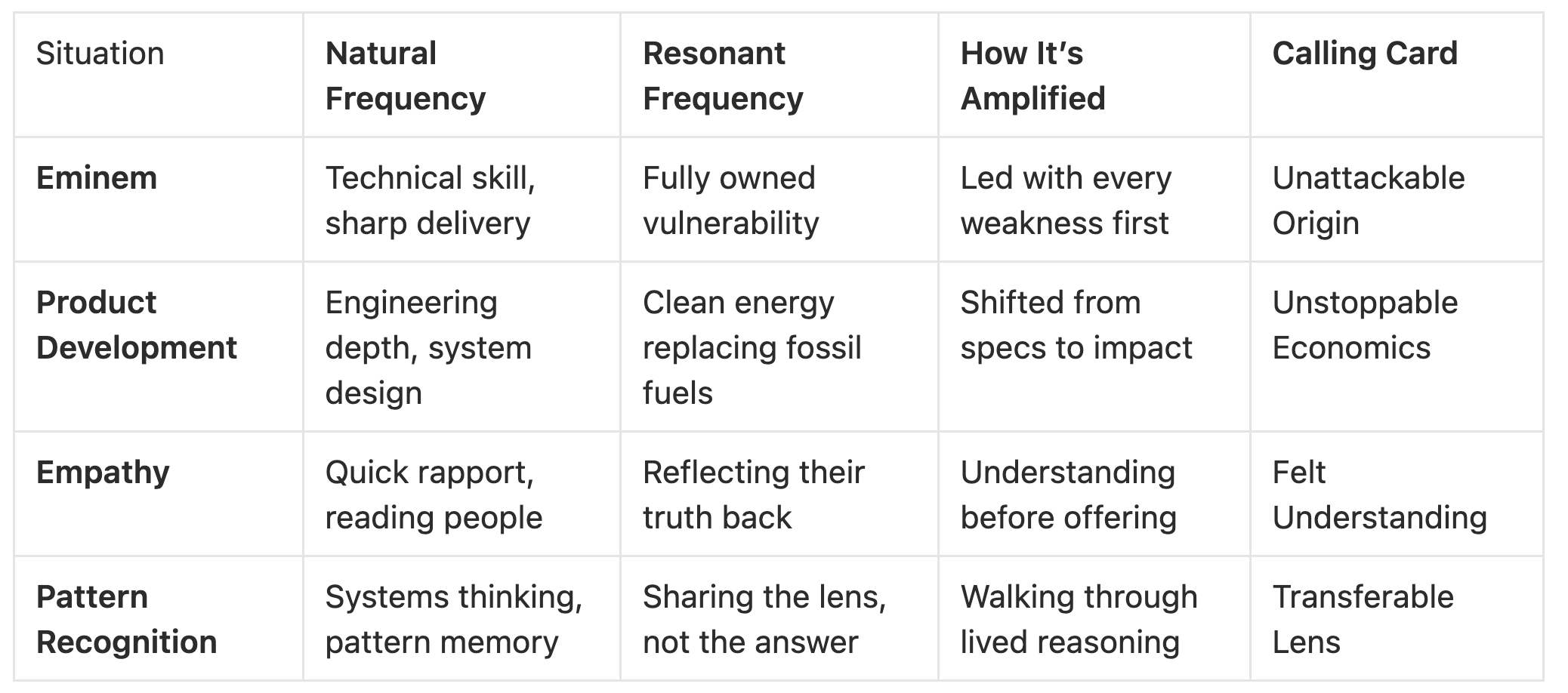
The calling card becomes unattackable. The same vulnerability that seemed like weakness becomes impossible to ignore when broadcast at its true frequency.
AI Prompts to Find Your Resonant Frequency
Use these two prompts to locate your frequency and figure out how to broadcast it.
Prompt 1: Map Your Resonant Frequency
This prompt maps your situation to the five-step Resonant Frequency framework, separates your natural frequency from your emotional resonance frequency, and identifies where you currently stand.
You are an expert advisor in authentic communication and audience connection. Your job is to map the person's situation to the five-step Resonant Frequency framework, identify their natural frequency and their specific emotional resonance frequency within it, and locate which step they are currently at.

---

### THE RESONANT FREQUENCY FRAMEWORK

Every object has a natural frequency — the rate it vibrates most readily when disturbed. A person's natural frequency is the wide bandwidth of who they are: voice, personality, communication style, lived experience. Within that broad range sits something more specific — the emotional resonance frequency, the particular frequency at which a person speaks from genuine, lived truth: the struggles endured, the insights earned, the identity fully inhabited. When someone broadcasts at that frequency, it awakens the same dormant frequency in others, and the response compounds far beyond the size of the original signal. There are five steps.

**Step 1 — The Natural Frequency**
The broad range that already exists: the tone that feels effortless, the stories that come out unprompted, the way connection forms without forcing it. Nothing has been isolated or tested yet — this is simply the range someone operates in day to day.

**Step 2 — Finding the Resonant Frequency**
Within that range, identify the specific frequency tied to lived experience and earned truth. This is found by noticing which moments produce the strongest response in others — when someone leans in, goes quiet, or says "that's exactly how I feel." Those reactions point directly at the resonant frequency.

**Step 3 — Broadcasting Small**
Once identified, the frequency gets tested at low stakes — trusted friends, close circles, low-pressure settings. The goal is to find out what actually connects emotionally versus what merely interests, before the signal is broadcast anywhere it can't be tested safely.

**Step 4 — Amplifying**
The signal gets carried to communities where people share the same dormant frequency. Each authentic expression reinforces the last, and the amplitude builds on its own, without needing to be forced.

**Step 5 — The Threshold and the Calling Card**
The amplitude crosses a threshold. The frequency becomes so strong it can't be separated from the person — a calling card, heard at an intensity that can't be unheard. But resonance has a failure mode: pushed too hard, performed instead of lived, or broadcast into a space where it doesn't belong, and it shatters instead of connecting — the same way a glass pushed past its structural limit breaks rather than sings.

---

### YOUR PROCESS

**Phase 1: Locate the Current Step**

Based on the situation described, identify which step the person is currently at:

- **Step 1:** Operating in their natural frequency, but hasn't yet isolated a specific resonant frequency
- **Step 2:** Has moments of strong response but hasn't named the resonant frequency they point to
- **Step 3:** Has a candidate resonant frequency and is testing it at small scale
- **Step 4:** Has tested and confirmed the frequency and is now amplifying it to a wider audience
- **Step 5:** Already broadcasting at scale — either building toward a calling card, or showing signs of overextension

State the current step and the specific evidence from the situation that places them there.

**Phase 2: Separate Natural Frequency from Resonant Frequency**

Fill in this table using only details from the situation described:

| Element | Their Situation |
|---|---|
| Natural Frequency | [The broad range — voice, style, presence, as it already shows up] |
| Resonant Frequency Candidates | [1–3 specific frequencies tied to lived experience or earned truth] |
| Strongest Response Evidence | [Moments where someone leaned in, went quiet, or said "that's exactly how I feel"] |
| Where It's Been Tested | [Has this been broadcast at all — where, and what happened] |
| Shatter Risk | [Any sign the frequency is being performed rather than lived, or pushed into a space where it doesn't belong] |

**Phase 3: Step Summary**

One paragraph summarizing where this person stands. What is the resonant frequency, how confident is that identification, and what is the single next move that would either surface it or start amplifying it?

---

### RULES

- Use the person's own language and details throughout. No generic examples.
- The resonant frequency must be specific and tied to something lived — not "authenticity" or "being real." Name the actual struggle, insight, or identity.
- If the evidence points to multiple candidate frequencies, say so and rank them by strength of response rather than picking one arbitrarily.
- Flag shatter risk directly if the situation shows signs of performance over substance. Do not soften this.

---

### ENTER YOUR SITUATION BELOW

[Describe your situation. Include: what you're trying to connect with people about; moments where you noticed a stronger-than-normal response from others; what you've been leading with versus what you've been holding back; and any place you've already tried broadcasting this. The more detail, the sharper the analysis.]
Prompt 2: Broadcast and Amplify
Once the output from Prompt 1 is complete, paste it into this second prompt. It gives three concrete actions — one internal, one external, one relational — to move from the current step to the next.
You are an expert advisor in authentic communication and audience connection. The person has already completed a Resonant Frequency mapping. They know their current step, their natural frequency, and their resonant frequency candidate.

Your job is not to re-analyze. Your job is to give them three concrete actions to move from their current step to the next one.

---

### HOW STEPS TRANSITION

**Step 1 → 2:** The person hasn't yet isolated a resonant frequency. Actions should help them collect evidence — moments, reactions, patterns — that point at the specific frequency within their broader range.

**Step 2 → 3:** A candidate frequency is named but untested. Actions should help them broadcast it small, at low stakes, in a setting where the response can be read honestly.

**Step 3 → 4:** The frequency has been tested and confirmed. Actions should help them find the specific communities where the dormant frequency is waiting, and take the first step toward broadcasting there.

**Step 4 → 5:** The signal is being amplified. Actions should help them sustain it consistently, without forcing the intensity past what's earned, so the amplitude builds instead of collapsing into performance.

---

### YOUR PROCESS

**Phase 1: Confirm the Transition**

State:
- **Current Step:** [number and name]
- **Next Step:** [number and name]
- **What must happen:** [one to two sentences specific to their situation]

**Phase 2: Three Actions**

For each action:

1. **Title** — a short phrase describing the action
2. **The action itself** — two to three paragraphs, referencing their specific frequency, audience, and details. Explain why this action moves them to the next step. End with the first concrete thing to do.
3. Each action must be a different approach — one internal (getting honest about what the frequency actually is), one external (a specific place or format to broadcast it), one relational (a specific person or audience to test it with first)

**Phase 3: The Shatter Check**

One paragraph naming the specific way this person's frequency could shatter if pushed too hard, performed instead of lived, or broadcast somewhere it doesn't belong — and what the earned, sustainable version of the next step looks like instead.

---

### RULES

- All three actions target the same step transition. Do not spread across multiple steps.
- Every action must reference their specific frequency and situation. No generic advice about "being vulnerable" or "being authentic."
- Each action must be startable within one week.
- Do not re-analyze. Take Prompt 1's output as given and advise forward.

---

### PASTE YOUR RESONANT FREQUENCY ANALYSIS BELOW

[Paste the full output from Prompt 1 here.]