

Applied Physics uncovers life’s hidden levers and how to use them. One physics-based framework with AI prompt each month to transform effort into compounding assets. If someone forwarded this to you, subscribe here.

Katalin Karikó arrived in the United States in 1985 with $900 sewn into a teddy bear and a single conviction: mRNA could be engineered to instruct cells to produce therapeutic proteins.
The scientific establishment was unmoved. Synthetic mRNA would trigger immune reactions, degrade too quickly, and never be stable enough for treatment. Funding dried up. Institutions moved on.
Instead, Karikó stayed by taking a low-level research position at the University of Pennsylvania, performing experiments in borrowed lab space, keeping mRNA as her focal point while everything else moved around her.
The resistance compounded. Grant application after grant application was rejected. Her collaborator left for the private sector. The university demoted her, stripping her path to full professorship.
Colleagues called her “that crazy mRNA lady.” She bounced between labs without reliable resources or recognition, her salary reduced to that of a technician. The scientific community had formally moved on. She continued anyway.
Then she noticed something. Transfer RNA – used as a control – didn’t provoke the same immune response as synthetic mRNA. She investigated alongside immunologist Drew Weissman.
The answer: natural RNA contains modified nucleosides that synthetic mRNA lacks, and the immune system recognizes that absence as foreign. By replacing uridine with pseudouridine, a naturally occurring modified version, they rendered mRNA non-immunogenic.
Cells accepted it without triggering inflammation. Proteins were produced. The core obstacle that had blocked the field for decades was gone.
When COVID-19 emerged, BioNTech and Moderna drew directly from her three decades of research to develop effective vaccines in under a year, while traditional development takes ten to fifteen.
An estimated twenty million lives were saved. In 2023, Karikó received the Nobel Prize in Physiology or Medicine. And the progress hasn’t stopped: mRNA therapeutics is now advancing treatments for pancreatic cancer, melanoma, HIV, and sickle cell anemia.
What the establishment dismissed as a dead end turned out to be one of the most abundant wellsprings in the history of medicine.
Karikó kept mRNA as her focal point while life continued around it. Year after year. Decade after decade. Thirty-five years.
The information and potential of mRNA was always there. What changed was the sustained attention: the deliberate choice to keep mRNA at the center of her work while everything else flowed around it.
She looked into what appeared to be empty space and, over time, discovered entire galaxies. What the scientific establishment dismissed as a dead end proved to be an abundant wellspring, not just for her but for millions of others.
This process mirrors exactly how the Hubble Space Telescope reveals distant galaxies from apparent darkness.
Finding Galaxies in Empty Space
Time integration (also called signal integration) is the practice of accumulating measurements over time to uncover signals too faint to detect in a single observation.
When a signal arrives too slowly to register on its own, repeated measurement allows it to compound until it becomes visible. Random noise fluctuates from one measurement to the next and largely cancels out, while the true signal reinforces itself with every addition.
The Hubble Deep Field demonstrates this principle, with one crucial prerequisite: absolute stability at a fixed focal point.
Before integration can begin, Hubble selects a precise patch of sky and locks onto it using guide stars and gyroscopes, holding its aim within 0.007 arcseconds. This is like focusing on a dime from 200 miles away. This focal point acts as a spatial filter, defining which photons to keep. Without it, photons from every direction would blur together, and no coherent image could form.
Once the focal point is set, integration begins. Over ten days, Hubble captures 342 separate exposures of the same region.
Photons from distant galaxies arrive at a trickle – perhaps one per minute – far too sparse to stand out in any single exposure. But stacked together, exposure after exposure, the signal accumulates. A single hour reveals nothing. A hundred hours, taken from the same fixed point, reveals thousands of galaxies.
Beyond astronomy, the same principle applies to any domain. Sustained focus on a specific domain reveals richness that remains invisible to diffuse attention.
A doctoral student narrows from all of biology to one protein mechanism. An apprentice woodworker focuses on joinery rather than all furniture-making. A scholar inhabits Borges instead of all Latin American literature. A violinist commits to one instrument rather than general musicianship. An entrepreneur goes deep in dental practice management rather than healthcare software broadly.
Signal integration is the long, patient commitment to that focus while life unfolds around it: years of reading the same author until patterns emerge that don’t exist for casual readers, a decade at the bench until grain patterns and heat colors become visible, 10,000 hours until the instrument reveals subtleties in tone production that beginners cannot perceive. What once appeared empty gradually proves abundant.
An entire galaxy emerges where others saw only darkness.
Finding a Career Within the Uncertain
When I was graduating from college with a degree in electrical engineering, I wasn’t sure which field to enter. Electrical engineering is broad, and many of its subfields are either being phased out, slowly evolving, or just beginning to emerge. Choosing a path meant weighing stability against innovation. Whether to enter an established field with reliable jobs or take a risk on something new.
That tension isn’t unique to engineering, but for me it felt especially important. This choice would define my career and industry for decades, so it couldn’t be something that might become obsolete in five years. I wanted a field with long-term relevance, real challenges, and room to grow.
I had a great experience at a summer research program, where I participated in the communications group. At the time, I thought digital communications – particularly image processing – would be my future. I enjoyed the coursework and was excited about the field.
However, when I applied to the PhD program, I wasn’t accepted. I didn’t secure the scholarship or funding needed to continue, and while I knew how competitive the space was, it was still discouraging. Even so, I kept searching for direction, trying to figure out where I truly belonged.
That turning point came through conversations with one of my professors, who was also a mentor. We started talking about clean and green energy. At the time, clean energy mostly meant solar and wind. Costs were coming down, but the technology still felt expensive and somewhat limited, and the industry wasn’t taken very seriously.
Still, it intrigued me. With my background in electrical engineering, I understood power systems and power flow, and I’d also taken mechanical and general engineering courses. I realized I had the tools to at least explore this space. So I did.
I asked myself: What is clean energy, really? Is it just more solar panels and wind turbines, or is there something deeper here? Is this a passing trend, or the foundation of a future industry? I started researching power grids, smart grid controllers, and energy systems. That led to more research, more videos, more books. Every resource I could find. I wanted answers. I wanted to know if this field had real substance, real problems to solve.
The more I learned, the more fascinated I became. I couldn’t stop thinking about it. I didn’t know exactly where the industry was going, but it felt solvable in the best possible sense – like a domain where engineering could genuinely enable a carbon-free, sustainable energy future.
Because of that, I chose not to take a job immediately after undergrad, even though I had graduated with honors and received awards. I wanted to fully understand this industry before committing myself to it.
I spent months reading everything I could: the leading books in clean energy, research on sustainability, and studies on the consequences of rising carbon emissions – which were often bleak and difficult to absorb. I dove into generation technologies, energy storage, carbon capture and sequestration, and emerging solutions from around the world.
The deeper I went, the more I uncovered. New engineering concepts, alternative approaches to storage, new methods for improving solar efficiency, and innovative programs shaping energy systems globally.
Eventually, it felt like I had stumbled into an entirely new galaxy. One I hadn’t even known existed. Clean energy was a young, rapidly evolving industry, and I felt like I had found it at exactly the right moment. That curiosity led to a job evaluating clean technologies, including smart homes, smart buildings, and energy storage systems. I also pursued side projects, like launching a podcast and writing a blog focused on energy technologies.
Looking back, committing myself to this field opened up a whole new world for me. I’m grateful I took the time to explore it deeply, and I’m excited to be part of an industry that’s still being shaped.
Finding Wellness by Rejecting the Cure
When I first moved away from home after graduating from college, I found myself in a completely new place – and dealing with persistent stomach issues. At the time, I didn’t realize the two were connected, but looking back, they almost certainly were. My diet hadn’t changed much from what I’d eaten growing up and in college, and my body was clearly reacting.
I was with a mainstream health insurance company then, so I went in and explained what was going on. Their response was straightforward: they prescribed a pill and told me to take it every morning. I did, and it worked.
When I followed up and asked what came next, the answer was simply, “Keep taking the pill.” That didn’t sit right with me. I was young, and the idea of taking a daily medication for the rest of my life without understanding the root cause didn’t feel like a real solution. I wanted another answer.
That curiosity led me to explore alternative healing methods. A friend recommended a local chiropractor who had helped people with stomach issues. I figured I had nothing to lose, so I gave it a try. He had his own unique approach, and while it didn’t immediately resolve the problem, I left each session feeling noticeably better. That was enough to make me think, maybe there’s something here.
At that point, I had a choice: go back to my insurance provider and continue taking the pill, or keep exploring other paths. I chose to keep exploring.
The place I went to offered a wide range of alternative healing practices such as acupuncture, chiropractor, special diets, and other therapies I had barely heard of before. I was determined to figure out what was actually going on with my body, so I tried everything. I signed up for introductory classes, figured out how to use my FSA credits to help cover the cost, and just kept experimenting.
I kept most of this to myself at first. I wasn’t sure it would work, and I didn’t want to recommend anything until I had real results. When I asked people around me about these practices, most didn’t know anything about them. That was discouraging, but it also made me more curious. So I kept going, meeting new practitioners along the way, some of whom were incredibly impressive.
One of them was even an electrical engineer, and we’d talk about things like Fourier transforms before diving into body mechanics. That combination of intelligence, curiosity, and effectiveness really stuck with me.
They introduced me to new diets, yoga practices, movement classes, and practitioners around town. Some without websites, some operating entirely through word of mouth. I tried them all. Along the way, I learned a tremendous amount and met people from all walks of life.
As I went deeper, my curiosity expanded. How did this relate to the nervous system? Why did my neck stiffness affect my stomach? Where did these issues originate? Today, answers might be found through a deep YouTube rabbit hole, but at the time this was hands-on learning.
I started reading constantly, asking every practitioner for book recommendations. One would lead me to another, and before I knew it, I had formed a community – a growing network of people focused on healing, learning, and understanding the body.
I took classes, earned certifications, and became part of this alternative healing community. The deeper I went, the more thoughtful and knowledgeable the people I met became, and I gained immense respect for many of them.
Eventually, my stomach issues resolved. It turned out to be a combination of reducing stress – since the nervous system is closely tied to digestion – and changing my diet to focus on nourishing, whole foods instead of processed ones that caused inflammation.
Today, I’m still connected to many of the practitioners I met along the way. We stay in touch, meet regularly, and continue learning from one another. Discovering this hidden world of alternative healing opened up an entirely new galaxy for me, one that I’m grateful to be a part of and excited to keep exploring.
Finding Depth by Preparing Longer
When I first started my career, instead of focusing on saving money or preparing to buy a home, I chose to spend my money traveling, really traveling the world. Like many people in their twenties, Italy was an obvious destination, so I decided to go.
Before the trip, though, I wanted to fully immerse myself in Italian culture and history. Even though I knew I might return someday, I treated the experience as if it were my only chance. I wanted to understand what I was seeing, to walk through the museums and towns with context, not just pass through them.
So I studied. I read books, including a biography of Michelangelo. I watched documentaries about the Renaissance and learned about the Medici family and their role as bankers and patrons of the arts. I explored Roman history, Renaissance history, and the lives of the artists and thinkers of the time. I even paid attention to Italian food and wine culture, wanting to absorb as much as I could before setting foot there.
When I finally arrived, the experience was incredible. Everywhere I went, the places felt alive because I knew their stories. In Venice, I understood why the city was built on water and remembered its role as a powerful mercantile hub. Walking toward the Colosseum, I imagined Roman soldiers marching through the streets.
In Florence, standing in front of Brunelleschi’s dome, I remembered how it was engineered and just stood there in awe. That knowledge anchored the moment. It turned a beautiful structure into a memory I’ll never forget.
Because I had prepared so thoroughly, I was also able to share what I’d learned with the people I was traveling with. I’d point things out, explain bits of history, and help everyone appreciate not just where we were, but why it mattered.
That preparation opened up an entirely new galaxy for me. On later trips where I hadn’t taken the time to learn the history beforehand, the places felt flatter, like being a visitor without a map. Italy was different.
Studying beforehand gave the trip depth, meaning, and lasting impact. In a sense, those weeks of preparation compressed decades of history and understanding into a single experience. It was absolutely worth it.
Discovering Wellsprings
The first step toward discovering a wellspring within what appears to be empty space is curiosity – questioning whether a wellspring might exist there at all. That curiosity may arise from dissatisfaction with a familiar, conventional path, or from a sudden change that demands movement toward something new.
The process begins by identifying where the empty space lies within a specific domain. The empty space exists where others have looked briefly and moved on, declaring nothing of value present. The next step involves searching for signals or clues that a wellspring may be forming beneath the surface. These signals often arrive as small contradictions or unexplained phenomena. They are faint, easily dismissed, but they indicate potential depth worth investigating.
Early observations and trial data come next. This stage involves exploring the domain without full commitment such as reading initial books, attending introductory classes, or trying different approaches. These early explorations cost time and money but remain exploratory, testing whether the domain warrants deeper focus.
Once glimpses of a potential wellspring emerge, establishing a focal point becomes essential. This means selecting a specific area within the domain – within the empty space – and deliberately directing attention there.
The focal point functions like Hubble’s guide stars: it defines which photons matter, filtering out noise and allowing signal to accumulate. Without this fixed point, attention scatters across too many directions and no coherent understanding can form.
Full immersion in the field follows. Using this focal point as an anchor, the process requires absorbing all relevant information as it arrives. Immersion means surrounding oneself completely with the domain, not as a brief project but as sustained practice over months or years.
Over time, synthesis transforms learning, research, and experiences into a coherent, comprehensive understanding of this once-empty space. Early observations begin connecting. What appeared scattered now forms a coherent whole.
From there, articulation and application of what has been discovered becomes possible. The new knowledge serves as a source, whether to build a career, secure a job, develop a network, or generate other forms of value to return to repeatedly.
At that point, the resource becomes a true wellspring: something that provides sustained, abundant value for the discoverer and for others as well.
Time integration requires a focal point, but that focus can narrow too far. Then immersion becomes isolation. It’s cutting off all inputs outside the chosen domain, and then the wellspring begins drying up rather than deepening. The goal is sustained focus with clear boundaries, not complete withdrawal into a single domain. Maintain activities and attention outside the single domain to prevent isolation.
The wellspring discovered through sustained immersion becomes renewable abundance: a domain to inhabit and draw from indefinitely, while others remain on the crowded surface, competing for obvious opportunities they can see at first glance.
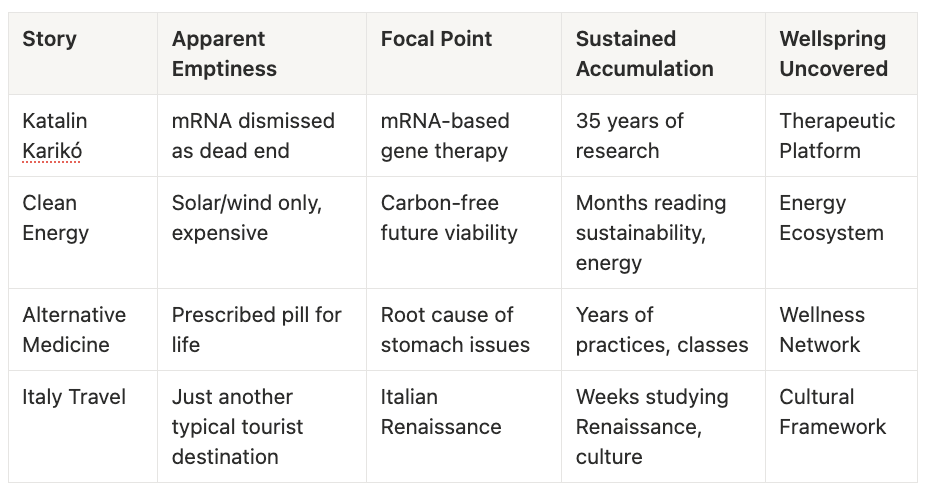
What appears empty to quick observation is actually full. Sustained focus reveals worlds that were there all along.
AI Prompt: Discover Your Wellspring
Use this prompt to map a domain you’ve explored deeply (or one you’re considering) against the signal integration framework. Paste it into an AI chat (I prefer Claude Opus 4.6) and describe your situation.
You are an expert advisor in sustained focus and domain mastery. Your job is to help the person map their experience against the Signal Integration Framework from Applied Physics, then produce a clear summary table.

---

THE SIGNAL INTEGRATION FRAMEWORK

In astronomy, the Hubble Space Telescope discovers galaxies invisible to the naked eye by locking onto a single patch of apparently empty sky and accumulating faint signals over hundreds of hours. Random noise cancels out. The true signal compounds. What appeared empty reveals thousands of galaxies.

The same principle applies to any domain. Sustained focus on a specific area — one that others glanced at and moved on from — reveals richness invisible to diffuse attention. The process has four stages:

1. **Apparent Emptiness** — A domain others dismissed, overlooked, or declared a dead end. What made it look empty to most people?
2. **Focal Point** — The specific question, problem, or conviction that locked attention in place. This is the guide star — it defines which signals matter and filters out noise.
3. **Sustained Accumulation** — The months or years of immersion: reading, practicing, experimenting, connecting. Each exposure adds signal. What accumulated over time?
4. **Wellspring Uncovered** — The abundant, renewable source that emerged. A career, a network, a capability, a body of knowledge others can't access from the surface.

---

YOUR PROCESS

**Phase 1: Identify the Domain**

Based on the situation described, name the domain the person has been exploring or is drawn to. State what makes it appear empty or unpromising to others — the specific reasons people dismiss it or move on.

**Phase 2: Lock the Focal Point**

Identify the specific question, conviction, or problem that anchors the person's attention. What are they pointed at? What filters their signal from noise? If no focal point exists yet, say so and help them define one from the details they've provided.

**Phase 3: Map the Accumulation**

List the specific things that have accumulated through sustained focus: knowledge, skills, relationships, credentials, experiences, patterns only visible after deep immersion. Name them concretely using the person's own details.

**Phase 4: Name the Wellspring**

If a wellspring has emerged, name it — the renewable source of value the person can draw from. If the person is still accumulating, describe what the wellspring could become based on the signals already present.

**Phase 5: Summary Table**

Fill in this table using only details from the situation described:

| Element | Their Situation |
|---|---|
| Apparent Emptiness | [What the domain looks like to outsiders — why others moved on] |
| Focal Point | [The specific anchor holding attention in place] |
| Sustained Accumulation | [What has compounded through months or years of focus] |
| Wellspring Uncovered (2-3 words) | [The renewable source that emerged, or is emerging] |

**Phase 6: One-Line Reframe**

Write one sentence that reframes what appeared empty into what it actually is — in the person's specific situation.

---

RULES

- Use the person's own language and details throughout. No generic examples.
- The focal point must be specific — not "I'm interested in the field." It is the precise question or conviction that acts as the guide star.
- If the person has no focal point yet, that is the most important finding. Without it, signal cannot accumulate. Help them define one before filling in the rest.
- Sustained accumulation is concrete: books read, skills built, people met, patterns recognized. Not "I spent a lot of time on it."
- A wellspring is renewable and abundant. If what they've found is a one-time benefit, it is not yet a wellspring — name what would make it one.
- Be direct. If the person is still at the early-curiosity stage, say so. The framework rewards honesty about where someone actually is.

---

DESCRIBE YOUR SITUATION BELOW

[Describe the domain you've been exploring or are drawn to. Include: what drew you in, what others think of this space, how long you've been focused on it, what you've done to go deeper (reading, classes, projects, conversations), what you've discovered that isn't visible from the surface, and what value has started to emerge. The more specific you are, the more precise the output.]