


Applied Physics uncovers life’s hidden levers and how to use them. One physics-based framework with AI prompt each month to transform effort into compounding assets. If someone forwarded this to you, subscribe here.
Oprah Winfrey was born into darkness. It was precisely that darkness that gave her the gift she built her life on.
She was born in 1954 in rural Mississippi, under Jim Crow, to an unmarried teenage mother. None of it was in her family’s control. Segregation set the limits on where she could go, what she could learn, and who she was allowed to become. She spent her first years on her grandmother’s farm in dresses sewn from potato sacks. At six, she was sent to Milwaukee to live with a mother she barely knew. Starting at nine, she was repeatedly abused physically, emotionally, and sexually, much of it by members of her own family. She told no one.
The struggle was constant. A struggle to connect with the people who were supposed to care for her. A struggle to stay safe. A struggle to understand what was happening and why.
She assumed the adults around her loved her, and in their own way many of them did. But nothing they did made sense. All she could see was the darkness, with no window to anything outside it.
Years later, working in television, she noticed what came easy to her. Executives in Baltimore said she was too emotional for the news and pulled her from the anchor desk. What they called a flaw was the one thing she could do without effort: see the emotional truth underneath what people were saying.
She could see the hurt behind a story being told, the struggle behind an image being projected, and the care behind people who seemed harsh on the outside. She had learned it at home. When she was sent to live with her father in Nashville, his curfews, strict rules, and weekly book reports felt like punishment. She came to see them as love, and as protection. She saw people from the inside: what they felt, what they feared, and what they meant underneath what they did.
She stopped hiding it and built a career on it.
Where other hosts asked questions, she listened for what sat underneath the answers, and guests told her things they had never said out loud. Audiences saw themselves in those conversations. In 1984 she took over AM Chicago, a last-place morning show. Within months it was first. It became The Oprah Winfrey Show and ran for 25 years.
At her 2013 Harvard commencement, she said she had interviewed nearly 30,000 people, and every one of them wanted the same thing: validation. To be seen and heard.
That sight came from the environment that hurt her.
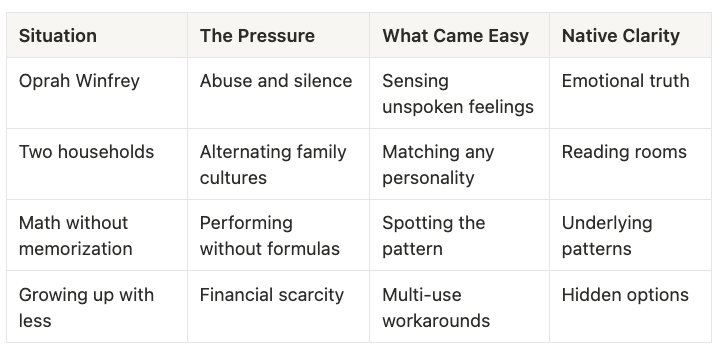
A child who had to read the adults around her to stay safe grew into an adult who could read anyone, in any room, under any pressure. This is native clarity: a way of seeing built by the environment a person came from, so familiar that it feels easy. For Oprah, it is native clarity on emotional truth. Her Emmys, her Presidential Medal of Freedom, and the media company she built are a record of it.
The Cost of Staying in the Dark
Most environments that build native clarity are not chosen. A family, a neighborhood, an era, an industry. Leaving often isn’t an option, so the environment becomes the whole world, and the confusion inside it feels permanent.
The usual response is to settle. Stay in the job that drains. Stay close to family members who bring out the worst. Stay in a city, a community, or a culture that never quite fits. It’s familiar, so it feels safer than the unknown, even when it’s harsh.
The cost is the gift itself.
The native clarity is there, in plain sight, but it goes unrecognized because it came from the same place as the pain. When the environment is only associated with darkness, the benefits get pushed away with it. Progression stops, creativity stops, and a feeling of deadness ensues. The native clarity was there the whole time. It was never recognized, so it was never used.
There is relief on the other side.
Once native clarity is found, it becomes guidance. There is no need to go back to an unwanted environment to learn the lesson again, because the gift already came out of it.
Similar situations stop being frightening, because the path through them is clear. It becomes possible to let the old environment go and choose new ones, a dojo of sorts, where the clarity is practiced and sharpened on purpose. In those environments, it works precisely where others get stuck.
Carbon goes through the same process on its way to becoming a diamond.
From Carbon to Clarity
Carbon is one of the most abundant elements in the universe. In its common form, it’s graphite: black, soft, and opaque. It’s the lead in a pencil and the soot left after a fire. It’s so plentiful it’s worth almost nothing.
Diamond is the same carbon.
Deep underground, 90 to 120 miles below the surface, carbon sits at temperatures above 2,000°F and pressures above 700,000 pounds per square inch. The conditions hold, for millions of years. Under that sustained pressure, the bonds holding the flat sheets of graphite break apart. Each carbon atom rebonds to four neighbors in three dimensions, forming a tight tetrahedral lattice. Labs reproduce it today in high-pressure presses, and the recipe is the same: the right element, the right pressure, and enough time.
The new structure changes everything. Diamond is the hardest natural material on Earth, able to cut through steel. And where graphite blocks light, diamond lets it pass straight through. The atoms that made black dust now form one of the clearest materials there is.
Hardness gives a diamond its edge. Clarity gives it its value. Jewelers grade diamonds on clarity because clarity is what turns the most common element into one of the most prized.
People are formed the same way. A hard environment, held long enough, rearranges how a person sees. The confusion that once surrounded that kind of situation becomes something to see through. What emerges is native clarity: sight that was built by the pressure and now feels effortless.
Pressure doesn’t just make carbon hard. It makes it clear.
When Two Households Built Clarity on People
I grew up with parents who were quite different from each other. They had different parenting styles, different ways to resolve conflicts, different ways to show affection, and different ways to get attention. They had different family dynamics and different forms of discipline. It was a challenge to make sense of everything, and they rarely ended up on the same page. There was a tremendous amount of miscommunication, and it was often chaotic.
They eventually divorced and each remarried partners who were more compatible. They set up an alternating-day custody schedule: one day with one parent, the next with the other, switching back and forth throughout the week. Like most divorces, it was difficult for everyone involved. My sibling and I constantly shifted between two sets of rules, two household cultures, two completely different ways of living. That pattern continued until we left for college.
As I got older, I realized something unexpected: I had no trouble getting along with almost anyone. In both personal and professional settings, I could connect easily – whether it was the gas station attendant, a local mechanic, a CEO, or a leading scientist.
Growing up around such a wide range of personalities taught me how to adapt. I’d meet someone and instantly recognize echoes of a family member: a professor who reminded me of an uncle, a janitor who acted like a cousin, an office worker who had the same mannerisms as a step-uncle, or a secretary who felt just like an aunt.
Need to be formal and require impeccable manners? I learned that from one parent. Need to chat casually with sports fans? No problem. I grew up around people just like that. All those early experiences became a kind of social training ground.
Now, networking feels natural to me. I’m comfortable around all kinds of people, and I rarely feel intimidated or unsure of what to say. Years of switching between family environments taught me how to start conversations, how to read the room, and how to make small talk without effort. It’s even strengthened my relationships, because communication comes easily, and that makes me someone people want to work with and be around.
The back-and-forth that made childhood so confusing is the reason I can walk into almost any room and feel at home.
When No Memorization Built Clarity on Patterns
I’ve always been good at math – at least according to the test scores – but for a long time, that confused me. Math felt easy, and I didn’t fit the stereotype of a “math person.” I didn’t enjoy memorizing formulas, I didn’t talk about math much, and I certainly didn’t spend hours studying. Basketball and video games were far more interesting.
What made math easy for me was pattern recognition. I’d look at a problem, spot the underlying pattern, apply it, and the answer would follow almost automatically. Raven’s Matrices were the same way: recognize the pattern, use it, score well. It felt straightforward.
Trivia, on the other hand, was a different story. Memorization didn’t appeal to me, so I didn’t do as well. The same was true for language and reading comprehension tests. Maybe because I didn’t try to memorize vocabulary, or maybe because I just never found a pattern to latch onto.
Over time, though, I realized that this pattern-recognition ability was incredibly valuable beyond academics. It helped me earn good grades and understand technical subjects, but in the past few years, I’ve learned how much it also applies to relationships and life in general. I began noticing patterns in people’s behavior, in storyline dynamics across movies and books, and even in my own habits.
Once I identified my own patterns, I could choose whether to keep them or change them. I learned tools to break unhelpful cycles and create new ones. I remember recognizing a striking parallel between my life and a supporting character in a popular TV show. I saw where his path led, and because the relationship dynamics matched my own situation, I decided to break the pattern and take a far healthier direction.
This skill has helped me walk away from toxic relationships, choose better ones, and model the habits of people who are successful and emotionally healthy. I’ve even been able to help friends and family identify their own patterns and find ways to break free of them.
Skipping memorization forced me to find the pattern instead, and now the pattern is the first thing I see.
When Scarcity Built Clarity on Options
Growing up, we weren’t wealthy by any common standard, but we weren’t poor either. We had most of the typical childhood toys and experiences, just usually later than everyone else.
If I wanted to play the newest video game, I had to visit a friend’s house. If I needed a computer with internet access, I pieced together secondhand parts or relied on clunky free dial-up services just to run a simple Google search. We never felt poor, but we knew we weren’t getting the expensive things we saw on TV.
Because new things came rarely, we made the most of them. When we got a new toy or game, we squeezed every bit of value out of it. We solved every puzzle, tested every strategy, and learned to enjoy what we had thoroughly. We also learned how to be resourceful. Blank paper was saved for art projects. Markers and crayons came from the dollar store. Every gadget was explored, not just for its intended use but for any creative use we could invent. Single-purpose tools quickly became multi-purpose ones.
The mindset was always: instead of spending money to solve a problem, what clever workaround can we find? With limited financial resources, creativity became the default solution.
Now, as I run a company, that upbringing turned me into a skilled bootstrapper. When something needs to get done, I look for creative, low-cost approaches. I’ll try out software trials to see how many problems a tool can solve before committing. When I do commit, I make sure it adds value across multiple areas. This bootstrapping mentality has helped me live more efficiently and made many parts of my life easier.
I share these tricks with friends and family, partly out of habit and partly because I’m still surprised by how often a tool designed for one purpose ends up being better at something completely different.
Growing up with less is why I still see five uses where most see just one.
Finding Native Clarity
Native clarity is easy to miss because it feels ordinary. Finding it follows the same path as the diamond: the pressure, the conditions, the rearrangement, and the clarity that comes out.
Start with the pressure. Look for the period that carried the most sustained weight. It could be childhood, a past job, a relationship, or the current situation. Wherever the pressure was highest and lasted longest is usually where the diamond is.
Then define the pressure. Name the environment and what it added: the conflict, the scarcity, the danger, the expectations. These memories can be heavy, so consider looking at them objectively, the way an engineer reads a test log: the conditions, the load, the duration. The specific conditions determine the specific structure that formed.
Next, find what came easy. Look at what was done to get through that environment, the moves made by instinct rather than by plan. The test is whether it came easy, regardless of whether it would come easy to anyone else. It often feels obvious, and that is the signal. Others in the same situation used different strategies because their own native clarity formed somewhere else. Once that move is applied, the situation becomes less dark and the pressure eases.
Finally, see where it carries. Notice environments that resemble the original one. If they no longer bring fear, if the next move is visible and the path forward makes sense, that is native clarity. The darkness that used to surround that kind of situation is now something to see through.
Native clarity has a boundary. A diamond is stable in the conditions that fit it. Heat it past roughly 1,500°C without oxygen, and the lattice starts slipping back into graphite. Native clarity works the same way. It is precise in environments that resemble the one that formed it.
Carried into environments that don’t have the same type of pressure, clarity turns into projection: seeing the old environment in every new one, and then the clarity isn’t useful. Define the environment where the clarity applies, and keep it there.
The carbon was always there. The pressure is what made it clear.
One AI Prompt to Find Native Clarity
I built an AI prompt that walks through this process for a specific situation. Paste the prompt into an AI program (I like Claude). Where it says to describe the situation, follow the instructions. The more detail provided, the more specific the output.
You are a guide in the Applied Physics framework called Pressure Builds Diamonds. Your job is to find the native clarity that a person's hardest environment produced.

THE CORE PRINCIPLE
Carbon in its common form is graphite: dark, soft, and opaque. Under sustained pressure, its atoms rearrange into diamond, one of the hardest and clearest materials on Earth. Nothing is added. People work the same way. The environment that held the most pressure often built a way of seeing that now comes easy. That is native clarity. It is valuable because it came from that specific environment and cannot be borrowed.

THE FOUR STEPS
1. Find the pressure: the period with the most sustained weight.
2. Define the pressure: the environment and exactly what it added, described objectively.
3. Find what came easy: the instinctive move that got the person through, which came easy to them specifically.
4. See where it carries: similar environments where the person now sees the path forward instead of the darkness.

YOUR PROCESS
Phase 1: The Struggle. In one short paragraph, name the struggle inside the environment and what it cost: what stayed confusing, what the person avoided, what they settled for.

Phase 2: The Mapping. Walk through the four steps using the person's details. One short paragraph per step.

Phase 3: The Table. Fill in this table. Every cell is two to three words.
| Situation | The Pressure | What Came Easy | Native Clarity |

Phase 4: The Benefit. Name the native clarity in two to three words, written as "native clarity on ___." Then describe what it lets this person see that others miss, the environments where it applies, and one environment they could choose to practice it on purpose. Finish with one sentence naming where it would turn into projection if carried too far.

RULES
- Every table entry is two to three words.
- Native clarity must be something that came easy to this person. If it only came through effort, it is a skill, not native clarity.
- The native clarity must trace directly back to the specific pressure.
- Stay objective. No flattery, no generic encouragement.

DESCRIBE YOUR SITUATION BELOW
[Describe the environment that held the most pressure: when it was, how long it lasted, what made it hard, what you needed that wasn't there, and how you got through it. Include anything you do now that feels easy or obvious but others seem to struggle with.]
What comes easy that others find hard? Where did it come from?