

Applied Physics uncovers life’s hidden levers and how to use them. One physics-based framework, lever, and AI prompt each month to transform effort into compounding assets. If someone forwarded this to you, subscribe here.
A few issues ago, I wrote about the White Light Principle – how dark emotions and bright emotions aren’t opposites. They are the same wavelength at different intensities.
That piece showed the pattern. This one turns the pattern into a process. It walks through J.R.R. Tolkien’s deepest loss and how he turned it into the most beloved story of fellowship ever written. Three AI prompts at the end help you apply the process yourself.

After a loss – the death of someone close, the loss of a job, even the loss of a familiar home after a move – there’s often a sense that something inside has gone missing.
There’s an ongoing pull to get back to how things felt before, to feel whole again, to recover what seems absent, even though the loss itself already belongs to the past.
This loss produces an emotional reaction, and that reaction is usually unwanted. Grief, sorrow, despair, depression, anxiety, overwhelm. These are common responses, and they get avoided because they feel too heavy, too painful, or too disruptive.
And yet it’s precisely this reaction that points the way forward.
After a loss, the experience fragments. Certain parts stay unprocessed, and those fragments hold important information. Hidden inside the darker emotion is anher emotion – its brighter counterpart.
When that counterpart is recognized and embraced, the experience starts to feel full again and to make sense. It completes the experience, brings closure, and makes what happened easier to understand.
The emotion being avoided is, in a sense, the same as its brighter counterpart – only dimmed.
When Buried Emotions Stay Buried
Here’s what usually happens after a loss such as a death, a failure, or a life change that hits harder than expected.
At first the emotions come fast. Grief, anger, fear, confusion. They overlap and pile on. The instinct is to push through. Get back to normal. Stay busy. People say “be strong” or “give it time,” and so that’s what happens.
The emotions go in a box, the lid closes, and life moves on. It preserves the appearance of stability – at the cost of significant time, energy, and emotional effort.
Except they don’t stay in the box.
The grief that got pushed down shows up as fatigue. The anger that got swallowed becomes tension. The fear that was never named quietly runs decisions in the background. Places, conversations, and situations that might crack the lid open get avoided. Everything looks fine on the surface, but only because of what’s being rejected underneath.
When emotions stay buried, the energy doesn’t disappear. It converts. It becomes physical symptoms, chronic stress, a shorter fuse, broken sleep, or a low-grade heaviness that never fully lifts. People carry that weight for years – sometimes decades – when they could have set it down.
The conventional advice doesn’t help much either. “Feel your feelings” is vague. “Talk to someone” assumes the words are already there. “Time heals” is passive. None of it gives a concrete process.
Most people aren’t missing awareness. They already know something is off. What’s missing is a path from where they are to the way through.
The Physics of Emotional Integration
In physics, white light appears when every color in the visible spectrum combines in the right proportions. Each wavelength – Red, orange, yellow, green, blue, indigo, and violet – carries their own wavelength and energy. Through additive synthesis, they blend into something no single color can create alone. Remove or weaken one wavelength, and the light is no longer fully white.
Emotional experience works the same way.
When an experience feels incomplete, it is often because one emotion has been resisted, muted, or pushed away. The difficult emotion is not a flaw in the experience. It is a dimmed form of something needed for the experience to become whole.
Dark and bright emotions are not opposites. They are complementary wavelengths on the same emotional spectrum.
Grief and honor both come from caring about someone. Fear and courage both come from facing something important. Doubt and conviction both come from caring whether something is true. The darker emotion is the brighter emotion at a lower intensity. It is not separate from the light. It is the same wavelength, dimmed.
After a loss, it can feel as though the inner lens has cracked. The light no longer comes together the way it once did. Some parts of the experience go dim. Others become distorted or split off. The full picture becomes hard to see because the emotional spectrum is no longer integrated.
The experience comes back together when the dimmed color is restored.
The brighter counterpart of the darker emotion comes forward. Grief reveals honor. Fear reveals courage. Doubt reveals conviction. The light becomes whole again. The inner lens comes back together, and the experience can finally be seen clearly, from beginning to end.
This is why the emotion being avoided is not blocking the path.
It is the path.
Lean into the darker emotion, and the brighter complement begins to appear. Bring the full spectrum to the surface, and the experience starts to integrate.
Here is the lever:
Lean into the darker emotion, and embrace the brighter emotion within it.
Run the process all the way through, and the brighter emotion comes forward. The next time the darker emotion appears, it no longer feels unfamiliar. It is recognized. It has been traveled before.
The emotion that once felt threatening stops being something to avoid, because the way through it is already known.
When it returns, it is no longer a crisis. It is understood as the dimmed form of a brighter emotion. The person knows what it contains, where it leads, and how to move through it.
And once that process has been lived, it can be taught.
When someone has walked all the way through a specific kind of loss, they become a guide for others still trapped inside it. The people who are still stuck see someone who made it through. They ask, “How did you do it? What helped you move forward?”
The answer can be handed over: show them the brighter emotion inside the darker one, and help them stop fearing the feeling they have been avoiding.
That is standing authority.
It is the credibility earned by living through both ends of the wavelength. The person who moves all the way through the experience gains a standing that cannot be taken away. Often, a body of work forms around it: writing, teaching, art, service, leadership, or simply a way of being that others recognize.
The thing that once broke them becomes the thing they can help others survive.
That is the gift the process leaves behind: becoming an authority on what was endured, and an inspiration to the people still standing where they used to be.
The Doubt That Made Me a Hard Tech Founder
Both flywheel energy storage startups ended.
Not because the vision was weak, but because, in the end, everyone involved doubted it.
At the start, there was belief. There was a vision, momentum, and a sense that we were building something that mattered. But beneath that momentum, doubt was always present.
Was this actually viable? Could it store meaningful energy? Could it ever be made cheaply enough? Could it become a real product, not just a compelling idea?
Everyone had made sacrifices to join. Each person had tied part of their identity, career, and future to the mission. And still, the doubt remained.
I had my own doubt too.
Should I keep going, knowing what it would take? Or should I give up on the idea entirely and move on?
After the second company ended, everyone I had worked with left the flywheel energy storage space and returned to their previous professions. These were smart, talented people. Part of the reason I had stayed in the work was because they were in it too. If they knew what they were doing, maybe I could follow their lead.
But when they walked away, I was left questioning everything.
Maybe they saw something I did not. Maybe they understood why it would never work. Maybe my own doubt had been trying to tell me the same thing.
That doubt was the emotion I wanted to avoid.
During the burnout that followed, and the slow recovery from it, I finally had time. So instead of dismissing the doubt or trying to overpower it, I looked straight at it.
I wanted to understand it.
What exactly were they doubting? What was I doubting? What did these smart people see that I did not?
I took every doubt seriously and addressed them one by one.
Maybe the concept did not work according to the laws of physics. Maybe the technology could not support it. Maybe the market was not ready. Maybe hard tech was too hard for one person. Maybe I needed the perfect team before anything could move. Maybe it simply was not meant to happen.
I examined each doubt until there was no longer a clear reason not to continue.
And as I leaned into the doubt, something unexpected happened.
I created conviction.
Every time I tried to answer a doubt, I learned something new about the technology, the market, or the business. Each doubt became a doorway into deeper understanding. Each question forced the company, the product, and the system to improve.
Questioning the use of carbon fiber in the flywheel revealed a path to cut cost by 90%.
Questioning whether we could build the power electronics and motor pushed round-trip efficiency past 97%.
Questioning whether the market was ready surfaced a beachhead market with more than 80% IRR on the first ten units.
Doubt and conviction were not opposites.
They were the same wavelength at different intensities.
My conviction did not grow because I ignored the doubt. It grew because I walked directly through it. I came to believe this product will be built someday, by someone, and my hope is to be there to help build it.
As that conviction grew, I started putting the work out front. The visibility led to conversations, opportunities, and a network I had not expected. Eventually, it led to a job I never saw coming when I started: a continuation of the same hard tech work, in a slightly different field.
Through all of it, I became a hard tech founder: someone committed to building physical technology in the world. Someone willing to sit with the hardest questions until they turned into design requirements, business strategy, and technical direction.
That conviction strengthened my career and gave me a clearer identity. It also gave me a framework I could hand to someone else: how to move through doubt, build conviction, and navigate hard tech.
The dark emotion I most wanted to avoid was the one that made me an authority in it.
When Tolkien’s Despair Built Middle-earth
Before the First World War, J.R.R. Tolkien belonged to a tight-knit group of four friends from school – the TCBS, as they called themselves. They were ambitious, creative, and certain they would change the world together through art and literature.
Tolkien was at Oxford studying philology, inventing languages, full of purpose. Fellowship, creative drive, and belonging all ran together. It just felt like life.
Then came the Battle of the Somme. Tolkien arrived at the front as a signal officer in 1916, into carnage on a scale that’s hard to hold: tens of thousands killed in a single day.

Lancashire Fusiliers fixing bayonets before the assault on Beaumont Hamel, 1916. Tolkien’s regiment. Public domain via Wikimedia Commons.
Over the months that followed, two of his four closest friends were killed. By the war’s end nearly all of his close companions were gone. The loss wasn’t only death. It was the loss of fellowship – the band of brothers who shared a creative vision for the future.
Tolkien was sent home with trench fever and spent months in hospitals carrying grief, horror, and the weight of what he’d seen. His contemporaries, the war poets, processed it through direct accounts of the trenches.
Tolkien took a different path. While convalescing, he began writing a mythology. His first work from this period was The Fall of Gondolin: a story of a city of high culture destroyed in a single blow by a nightmarish army. He later said his taste for stories of this kind was quickened to full life by the war.
The despair was the creation, dimmed. Both came from the same source: a devotion to fellowship, beauty, and meaning. When Tolkien leaned into the grief instead of away from it, it became the foundation for an entire world.
The Dead Marshes echo the Somme. The hobbits were modeled on the ordinary soldiers he served beside. And the story at the center of it all is the story of a fellowship.
The loss of fellowship became the creation of fellowship. What the war took from Tolkien, he made permanent in story: a depiction of brotherhood so enduring it has brought millions of people together across a century.
A century after the Somme, Tolkien remains the world’s authority on fellowship. His standing authority has a name everyone knows on sight: the Fellowship of the Ring.
Six Steps to Make the Light White
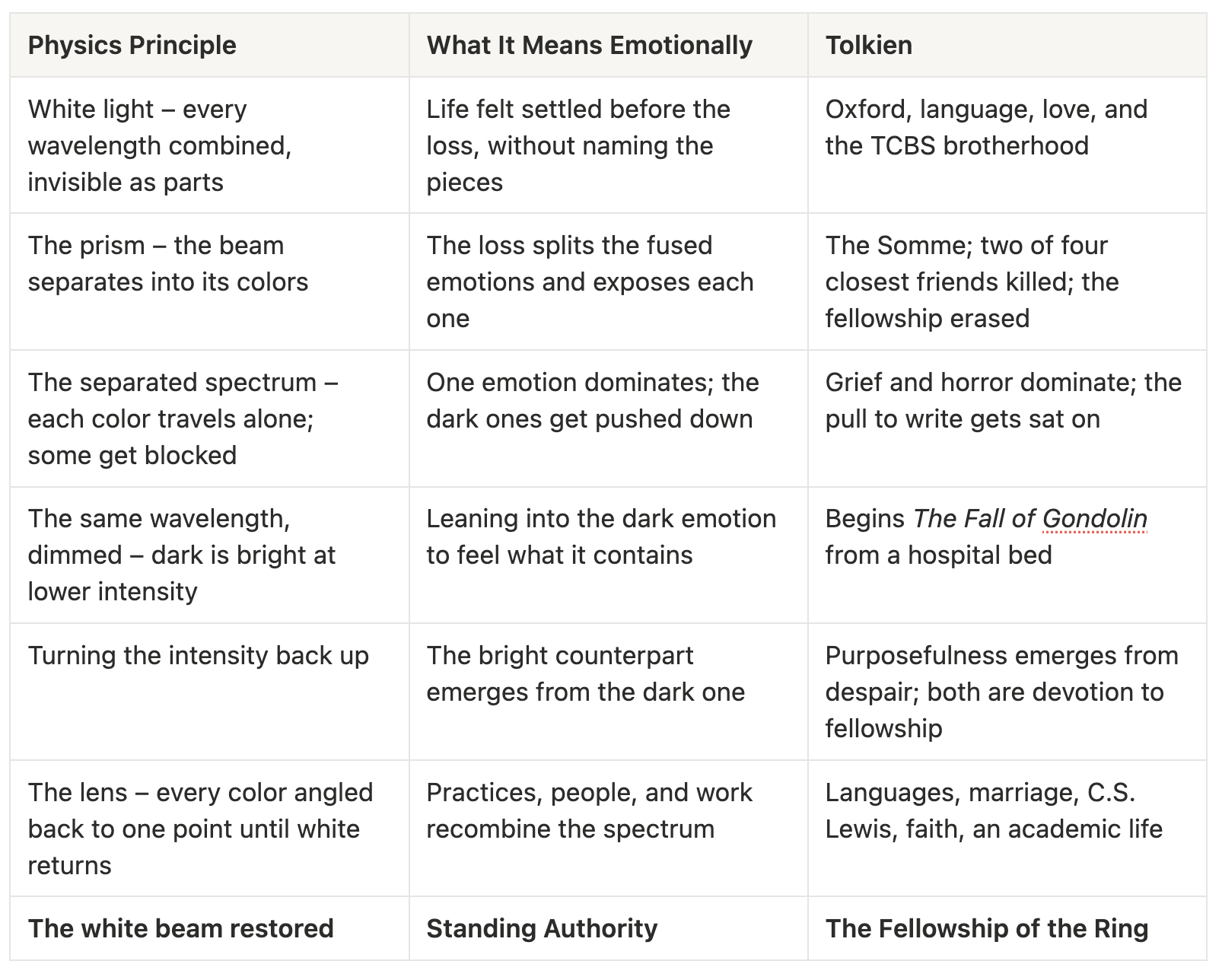
The process mirrors how light moves through a prism and reconverges through a lens. Each step is the same physics. Once as light, once as the experience it parallels.
Step 1 – White Light: Before the Loss
White light is every wavelength combined at once. The separate colors don’t show; it just reads as white, and nothing about it stands out. Life felt the same way before the loss. Joy, security, purpose, and connection ran together. It didn’t feel extraordinary. It just felt like life. Nothing registered as separate because nothing was missing.
Step 2 – The Prism: The Loss
A prism bends each wavelength by a different amount and separates the beam into the spectrum that was inside it the whole time. A loss does the same. It pulls apart the ones already being carried and exposes each one. The loss can be a death, a layoff, a divorce, a diagnosis, a failed company, or the end of an identity. That’s why loss is disorienting. The full spectrum is spread out and visible for the first time.
Step 3 – The Separated Spectrum: One Color at a Time
Once separated, each color travels its own path. Look through a single band and only red shows, or only blue. Never the whole. After a loss, one emotion dominates at a time – just grief, just anger, just numbness – and each feels like the whole picture because it’s the only filter present. Meanwhile certain colors get blocked. The blocked energy doesn’t vanish. It converts into fatigue, tension, or physical symptoms.
Step 4 – The Same Wavelength, Dimmed: Lean In
A dim red and a vivid red are the same wavelength at different intensities. The dark version isn’t a different color; it’s the bright one turned down. The dark emotion is its bright counterpart dimmed. Instead of turning away, lean into it to feel what it contains.
Step 5 – The Bright Counterpart Emerges
Turn the intensity back up and the color is restored. Same wavelength, full brightness. Once the lean-in happens, the bright counterpart emerges on its own. Grief reveals honor. Anxiety reveals preparedness. Doubt reveals conviction. Fear reveals courage. Depression reveals purposefulness. This is recognition, not forced positivity.
Step 6 – The Converging Lens: White Light Restored
A lens takes the separated colors and angles every one back to a single focal point, where they recombine into white. The lens here is built from practices, the right people, an environment, a frame, and the work where the emotion gets put to use. Every color converges.
The light goes white again, the same as before, but now every color inside it is known. What’s left is standing authority: the credibility, and usually a body of work, earned by living through both ends of the wavelength. Convergence is rarely perfect on the first pass. A flicker of resentment, a trace of old fear. Those are normal, and they get cleaner each time the process runs.
Three Prompts to Walk Through This Process
Three prompts walk through this process, in sequence.
Prompt 1 finds where things stand. It maps a situation to the six steps and names the dark emotion, its bright counterpart, the wavelength they share, and the standing authority waiting at the end.
Prompt 2 gives the next move. It takes that map and returns three concrete actions to get from the current step to the next. One internal, one external, one relational.
Prompt 3 is the one built for White Light. It goes back to the original loss and maps every color the loss dimmed, not just the obvious one – because the light can’t go white until all of them come back.
The three prompts are below, for paid subscribers.